



For decades, accredited investors have relied on public equities, real estate, venture capital, and large-cap buyouts to drive portfolio growth. Yet one of the most compelling opportunities in today’s market remains under-allocated: value investing in small businesses. At SMB Value Investing Group (SMB VIG), we focus on disciplined, data-driven participation in private SMB investments-targeting durable cash-flowing companies in the lower middle market.
With more than 30 million small businesses operating in the United States and trillions of dollars expected to transition as baby-boomer owners retire, the environment for small business acquisition investing has rarely been stronger. This is not speculative venture investing. It is practical, cash-flow-focused, Main Street business investing built on fundamentals, alignment, and long-term value creation.
Why Private SMB Investments Stand Out
SMB investing offers a unique combination of return potential, downside protection, and portfolio diversification. Unlike public stocks, where pricing fluctuates daily based on sentiment, private business performance is driven by operations, leadership, and local demand.
Historically, lower middle market investing has generated compelling returns through three core drivers: operational growth, disciplined leverage, and multiple expansion at exit.
Operational improvement often represents the most immediate opportunity. Many small businesses are founder-led and under-optimized. Improving pricing discipline, upgrading systems, strengthening sales processes, and professionalizing financial reporting can expand EBITDA without relying on unrealistic growth projections.
Debt deleveraging adds a second layer of compounding. When acquisitions are structured conservatively, business cash flow pays down acquisition debt over time. As leverage declines, equity value grows disproportionately—creating long-term wealth even in steady-growth environments.
Finally, valuation arbitrage provides structural upside. Private equity small business investments frequently begin at entry multiples between 3–6x EBITDA. As companies grow and institutionalize, they may command higher exit multiples. Buying small and selling bigger is not a slogan-it is a measurable source of alpha.
At SMB Value Investing Group, we view this through the lens of value investing in small businesses: purchase at rational valuations, improve fundamentals, protect downside, and compound patiently.
Margin of Safety in Main Street Business Investing
One of the strongest advantages of small business investing is valuation discipline. In contrast to overheated segments of venture capital or growth equity, small business acquisition investing often begins at sensible pricing levels.
Lower entry multiples reduce dependence on aggressive assumptions. Even if revenue remains stable, investors can achieve attractive returns through cash generation and debt repayment. This built-in margin of safety is central to our philosophy at SMB VIG.
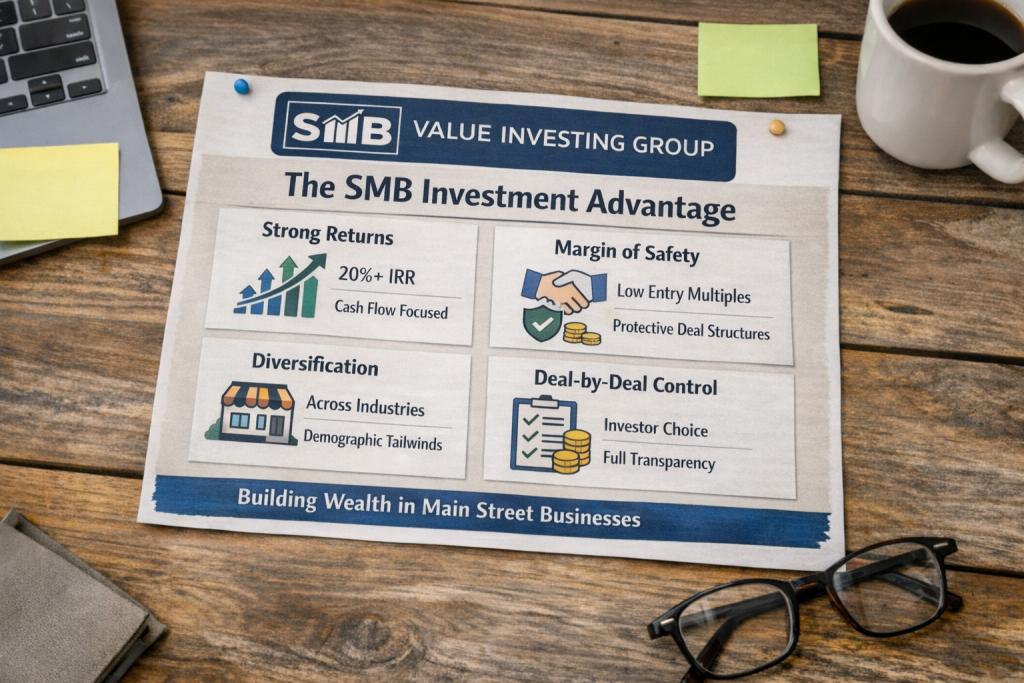
Deal structures further protect capital. Seller financing is common, aligning incentives between buyer and seller. Sellers frequently retain minority equity positions, reinforcing continuity and long-term commitment. Preferred return structures ensure that investors receive priority distributions before sponsors share in upside.
In many cases, the businesses we evaluate convert EBITDA into free cash flow at high rates. This reduces reinvestment risk and supports debt service, growth initiatives, and potential distributions. For accredited investors seeking stability within private market investing, these characteristics are particularly attractive.
Diversification Through Lower Middle Market Investing
Demographic tailwinds continue to support private SMB investments. Thousands of business owners reach retirement age each year, creating a steady pipeline of opportunities across healthcare services, IT providers, niche manufacturing, and recurring B2B businesses.
This environment enables thoughtful diversification. Rather than concentrating capital in a single venture-backed startup or a blind-pool fund, investors can build exposure across industries and geographies. Lower middle market investing allows portfolios to balance cyclicality while reducing single-asset risk.
Because private businesses are valued on cash flow and succession-driven transactions-not public market volatility-they often show lower correlation to traditional equities. This makes private equity small business investments a strategic complement to public holdings.
At SMB Value Investing Group, diversification is not accidental. It is a deliberate outcome of disciplined underwriting and selective participation.
The SMB VIG Investment Process
Transparency and structure are essential in private markets. Our SMB VIG investment process is designed to provide clarity, discipline, and alignment at every stage. For accredited investors, understanding the small business investment process is just as important as understanding the opportunity itself.
Our approach follows a clear step-by-step investment process, beginning with initial sourcing and screening. Each potential acquisition undergoes a structured investment opportunity review, where we assess industry dynamics, recurring revenue stability, customer concentration, and cash flow consistency.
The next stage includes a comprehensive executive summary review. Investors receive a concise but thorough overview of the business model, financial performance, risks, growth strategy, and projected returns. This forms the foundation of our private business investment guide for each opportunity.
Due diligence follows. This phase of the SMB deal investment steps includes financial validation, quality-of-earnings analysis, operational assessments, and management evaluation. We focus heavily on downside protection—testing assumptions rather than simply validating upside projections.
Once diligence is complete, investors participate in a deal-by-deal investing process. Unlike blind-pool structures, our model allows accredited investors to decide whether a specific transaction aligns with their risk-return goals. This accredited investor investment process emphasizes choice, pacing, and transparency.
Post-close, our private market investing process continues with active oversight, operational support, and performance monitoring. Clear reporting ensures investors remain informed about business performance and capital allocation decisions.
This structured framework reflects our belief that disciplined execution matters as much as sourcing. The SMB VIG investment process is built to protect capital first and pursue growth second-never the other way around.
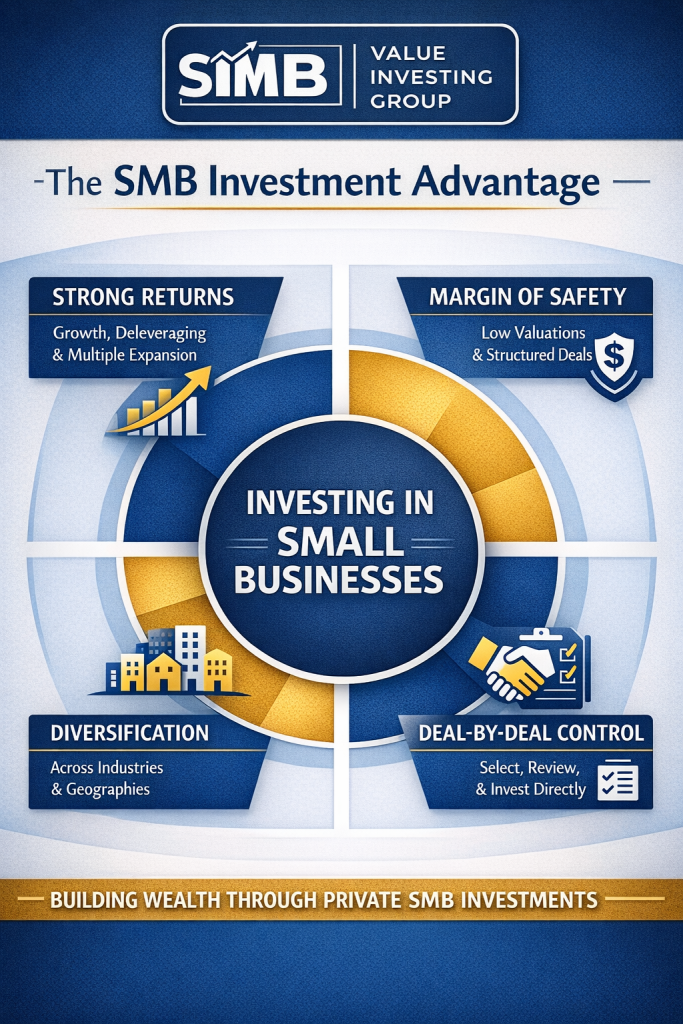
Deal-by-Deal Flexibility and Alignment
One of the defining strengths of our model is flexibility. The deal-by-deal investing process empowers investors to evaluate opportunities individually rather than committing to a fixed mandate.
This allows for selective deployment. Investors can increase exposure to industries they understand well and pass on transactions that fall outside their comfort zone. Capital pacing can be managed intentionally, reducing vintage-year concentration risk.
Alignment is equally important. Sponsors and operators typically invest alongside limited partners, ensuring shared incentives. Performance-based economics reward execution only after investor capital achieves preferred thresholds.
For many accredited investors, this transparent and structured accredited investor investment process offers a level of visibility and partnership not typically available in traditional fund models.
A Practical Private Business Investment Guide for Long-Term Value
At its core, small business acquisition investing is about stewardship. It involves acquiring essential businesses-often family-built enterprises-and guiding them into their next stage of growth.
The opportunity today is supported by durable fundamentals: demographic transitions, rational valuations, operational improvement potential, and steady cash flow generation. For investors seeking exposure to private equity small business investments without speculative risk profiles, this segment offers balance.
SMB Value Investing Group approaches each opportunity through a disciplined private business investment guide that prioritizes underwriting rigor, alignment, and sustainable value creation. We believe that thoughtful value investing in small businesses can generate resilient returns while strengthening the backbone of the real economy.
Final Thoughts
Private SMB investments are no longer a hidden corner of the market. They represent a scalable, structured, and repeatable strategy within lower middle market investing. Through a defined SMB VIG investment process, transparent deal-by-deal investing process, and disciplined investment opportunity review framework, accredited investors can access institutional-quality opportunities with meaningful downside protection.
In a market environment where many asset classes appear fully priced, Main Street business investing continues to offer rational valuations and operational upside. By combining valuation discipline, structured underwriting, and alignment-driven execution, SMB Value Investing Group aims to help investors build durable, diversified wealth through private business ownership.
For those ready to explore small business acquisition investing with clarity and confidence, the opportunity is not theoretical-it is already underway.