

Red Flags and Yellow Flags Uncovered During SMB VIG’s Diligence Process
Investing in small and medium-sized businesses (SMBs) requires more than optimism about growth. It requires a disciplined understanding of risk.
At SMB Value Investing Group (SMB VIG), our diligence process is designed to separate manageable complexity from unacceptable risk. Every opportunity carries uncertainty. The key is identifying which risks can be structured, mitigated, and priced appropriately—and which risks threaten long-term capital preservation.
To maintain clarity and consistency, we categorize diligence findings into two primary buckets:
- Red Flags – structural or behavioral risks that are typically deal-breakers
- Yellow Flags – manageable risks that require pricing discipline, structural protections, or operational planning
This framework allows SMB Value Investing Group to remain selective without becoming rigid. We protect investor capital while staying open to opportunities where risk is properly understood and compensated.
🚩 Red Flags: When Walking Away Is the Right Decision
Red flags are issues that materially threaten governance integrity, sustainable cash flows, or downside protection. Even attractive returns cannot compensate for structural fragility.
Unreliable or Unverifiable Financials
If bookkeeping is inconsistent, adjustments are unexplained, or historical statements are incomplete, confidence in reported earnings declines quickly. In SMB investing, reliable historical performance is the foundation for underwriting. Without credible data, projections become speculation. At SMB VIG, transparency in financial reporting is non-negotiable.
Unsustainable Earnings Quality
Inflated EBITDA driven by aggressive add-backs, temporary cost deferrals, or one-time projects creates a distorted valuation picture. When earnings quality is weak, leverage becomes dangerous. Inflated profits may support a higher purchase price on paper, but they rarely translate into durable cash flow post-close.
Excessive Customer Concentration
Revenue that depends heavily on one or two customers – without long-term contractual protection—creates structural vulnerability. The sudden loss of a major customer can materially impair equity value. While concentration can sometimes be mitigated, extreme dependence without clear retention visibility is often a deal-breaker.
High Churn and Low Switching Costs
If customers can easily leave, pricing power is weak, and competitive barriers are minimal, the business may lack durability.Strong SMB investments typically exhibit sticky relationships or differentiated service offerings. Structural fragility increases downside risk, particularly during ownership transitions.
Sponsor or Operator Misalignment
Alignment becomes critical during challenging periods. Undercapitalized sponsors, excessive fee structures, or unwillingness to commit meaningful equity can signal misaligned incentives.
At SMB Value Investing Group, we prioritize operator commitment and shared economic exposure. Alignment is not theoretical-it is behavioral.
Legal, Regulatory, or Compliance Landmines
Pending litigation, regulatory non-compliance, or licensing gaps can introduce binary risk. These issues are often costly and difficult to fully insure against. Legal clarity is essential to protecting long-term enterprise value.
Excessive or Fragile Leverage
Debt structures that rely on optimistic growth assumptions or thin covenant cushions can turn manageable operational challenges into existential threats. SMB VIG maintains a conservative view of leverage. Debt should support growth-not create fragility.
Cultural, Ethical, or Reputational Concerns
Culture is one of the hardest variables to change post-acquisition. Evidence of unethical behavior, poor employee treatment, or reputational risk often signals deeper systemic problems. Financial performance can be improved. Cultural integrity is much harder to repair.
When red flags surface, discipline matters. At SMB Value Investing Group, walking away is often the most value-creating decision.
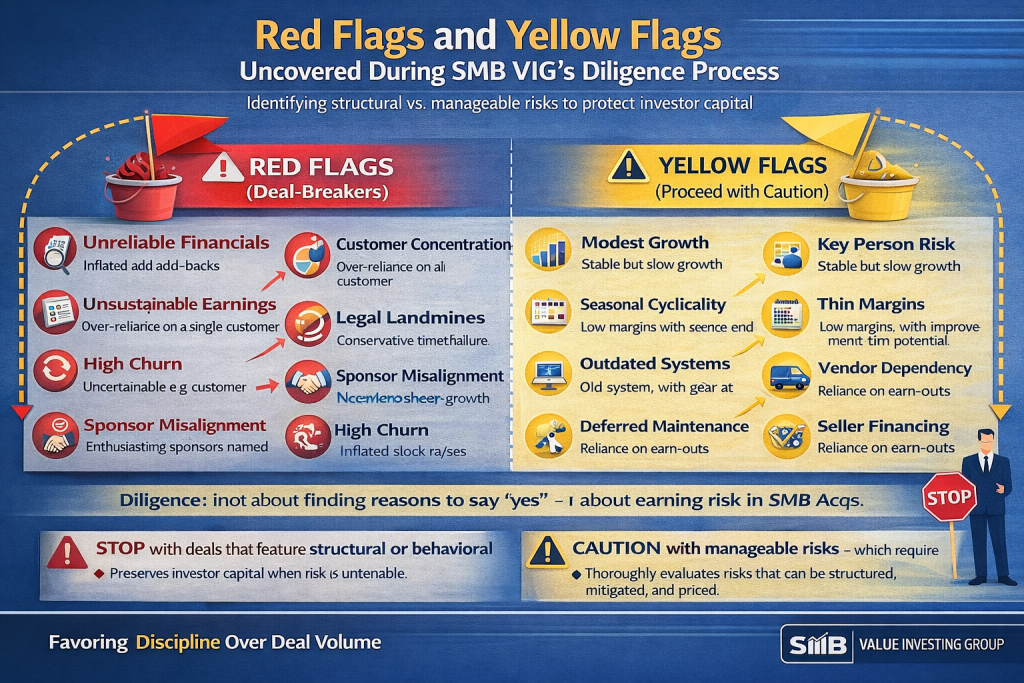
⚠️ Yellow Flags: Risks That Require Structure and Strategy
Not every concern disqualifies a business. Many SMBs have imperfections that can be addressed through thoughtful structuring, conservative underwriting, and operational focus. Yellow flags require caution-but not necessarily rejection.
Flat or Modest Growth Profile
Some businesses demonstrate stable cash flow but limited organic growth.
Rather than dismissing these opportunities, SMB VIG evaluates them through a cash-yield and operational-improvement lens. In certain cases, predictable earnings with margin expansion potential can deliver attractive risk-adjusted returns.
Key Person Dependency
Heavy reliance on a single owner or executive is common in founder-led SMBs.
Mitigation strategies may include transition agreements, equity rollovers, structured incentive plans, and leadership development initiatives. The objective is to reduce dependency over time.
Seasonality or Cyclicality
Revenue concentrated in specific periods or tied to economic cycles introduces volatility.
We address this through conservative working capital assumptions, liquidity buffers, and stress-tested financial models.
Limited Technology or Systems Maturity
Outdated accounting platforms or manual operational processes are common in smaller businesses.
Rather than viewing this as disqualifying, SMB Value Investing Group evaluates whether targeted post-close investments can create operational leverage and better visibility.
Thin Margins with Improvement Potential
Below-peer profitability can signal inefficiency-or opportunity.
If margin gaps are identifiable and operational levers are realistic, disciplined pricing and execution can drive improvement. Conservative valuation becomes critical in these scenarios.
Supplier or Vendor Concentration
Dependence on a single supplier for key inputs creates procurement risk. Mitigation may involve developing secondary sourcing strategies or renegotiating supplier agreements post-close.
Deferred Maintenance or Capex Requirements
Underinvestment in facilities or equipment is common in closely held businesses. We incorporate realistic capital expenditure reserves into underwriting to avoid surprises and ensure ROI discipline.
Seller Financing Complexity
Seller notes and earn-outs can align interests—but they can also introduce friction if poorly structured. Clear documentation, subordination terms, and aligned incentives are essential to protecting both parties.
Yellow flags require analysis and structure. When appropriately priced and mitigated, they can create opportunity rather than risk.
How SMB Value Investing Group Responds to Risk
Our response framework is straightforward:
- Red Flags typically lead to declining the opportunity. Capital preservation is paramount.
- Yellow Flags are addressed through pricing adjustments, governance rights, conservative leverage, and active post-close engagement.
At SMB Value Investing Group, we believe risk ignored is risk magnified. Risk identified, structured, and actively managed can be responsibly underwritten. Diligence is not about perfection. It is about clarity.
Our Philosophy: Discipline Over Deal Volume
In competitive SMB markets, there can be pressure to close transactions quickly. We take a different approach.
SMB Value Investing Group prioritizes transparency over optimism. We emphasize alignment over leverage. We favor durability over growth at any cost. Our diligence framework ensures that every investment we pursue reflects thoughtful underwriting, strong governance, and realistic downside protection.
We are comfortable passing on opportunities that do not meet our standards. Protecting investor capital requires patience.
Explore the SMB VIG Diligence Process
Understanding risk is foundational to successful SMB investing. Our diligence process is designed to evaluate earnings quality, cash flow durability, governance integrity, and structural resilience before capital is deployed.
If you would like to learn more about how SMB Value Investing Group evaluates small and medium-sized business investments, we welcome the conversation.
Diligence is not about finding reasons to say “yes.”
It is about earning the right to invest with confidence.