

Misunderstanding working capital is one of the most common causes of liquidity stress after a business acquisition. This is particularly true in small and lower-middle-market transactions, where even minor miscalculations can create significant financial strain. For investors in these markets, accurate financial analysis is essential. Overpaying for a business or underestimating operational risks can quickly turn a promising investment into a financial challenge.
At SMB Value Investing Group, we ensure that every investment decision is grounded in a clear, data-driven understanding of a business’s financial health. One of the most powerful tools in our diligence process is the Quality of Earnings (QoE) analysis. By providing a normalized view of earnings, a QoE review helps investors make informed decisions, understand realistic leverage opportunities, and anticipate potential returns.
Learn more about our SMB Value Investing Group Investment Diligence Process.
What Is a Quality of Earnings Review?
A Quality of Earnings review goes beyond the numbers on a financial statement. While reported earnings may appear strong, they often do not reflect temporary fluctuations, one-time events, or accounting decisions that can distort the true earning power of a business.
The purpose of a QoE review is to uncover these anomalies and produce a realistic picture of sustainable earnings. This process is especially critical in SMB investing, where owner discretion is high, and financial transparency may be limited. Without a QoE analysis, investors risk relying on reported EBITDA that does not accurately reflect ongoing performance.
EBITDA Normalization: Understanding True Earnings
EBITDA normalization is a key component of a Quality of Earnings review. This process adjusts earnings to remove the effects of unusual or one-time events. Common adjustments include:
- Temporary cost deferrals that inflate short-term profitability
- One-time revenue spikes from special contracts or projects
- Operational disruptions that are unlikely to recur
By isolating sustainable earnings, normalized EBITDA becomes the foundation for accurate valuation, leverage assumptions, and return projections. For investors, this level of insight is invaluable in negotiating purchase price and structuring financing.
Explore why we prefer independent sponsor deals over self-funded searches.
Why Quality of Earnings Matters
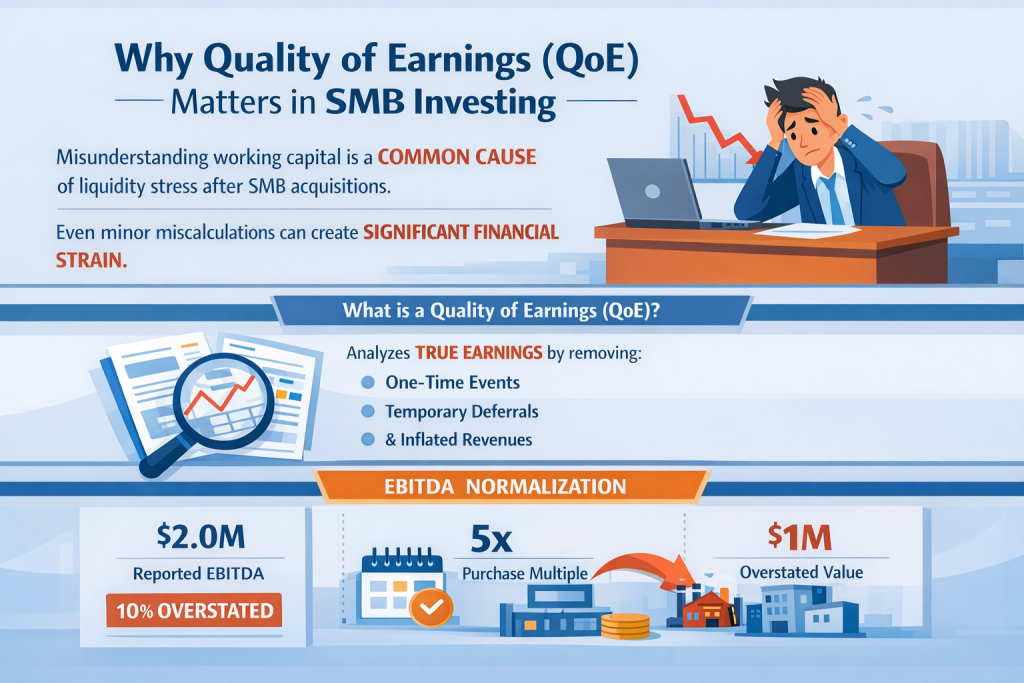
In small and lower-middle-market deals, it is common for reported EBITDA to be inflated by 10–25% due to aggressive add-backs. Sellers and intermediaries may present an optimistic earnings story, often without malicious intent, simply reflecting the way the business has been historically managed. However, even small discrepancies can significantly impact the value of a deal.
Consider this illustrative example:
- Reported EBITDA: $2 million
- Overstatement: 10% ($200,000)
- Purchase multiple: 5×
In this case, the overstated EBITDA would inflate the enterprise value by $1 million—a substantial amount that could have been avoided with a QoE review. At SMB Value Investing Group, we use QoE analyses to ensure investors are not paying institutional prices for non-institutional earnings. This protects our investments and aligns expectations between buyers and sellers before closing.
Cost Versus Value of a Quality of Earnings Review
Many investors view a Quality of Earnings review as an optional expense, but the reality is that its cost is often minimal compared to the potential savings. Typical QoE engagements range from $30,000 to $75,000, depending on the complexity and size of the deal.
In practice, the insights gained from a QoE review often result in:
- Reduced purchase prices or adjusted deal terms
- Modified leverage assumptions to reflect realistic debt service capacity
- Deal restructuring or even deal abandonment if risks outweigh the opportunity
It is not uncommon for QoE findings to save investors seven to ten times the cost of the report by uncovering risks that would have otherwise been hidden until after closing.
Integrating QoE Insights Into Investment Strategy
At SMB Value Investing Group, the findings from a Quality of Earnings review are fully integrated into our broader investment diligence process. We do not treat QoE as a check-the-box exercise. Instead, it informs critical decisions across multiple aspects of an investment:
- Valuation and Negotiation: Accurate, normalized earnings provide a solid foundation for purchase price discussions.
- Capital Structure and Leverage Decisions: Understanding true cash flow helps us structure debt responsibly and minimize financial risk.
- Risk Disclosures and Investor Communication: We maintain transparency with our investors by highlighting both opportunities and risks identified in the QoE.
- Go/No-Go Decisions: QoE findings can decisively influence whether we move forward with an investment or walk away.
This disciplined approach ensures that every investment aligns with our risk-return expectations and provides clarity for both our team and our investors.
QoE as Insurance for Investors
A Quality of Earnings review is not a luxury—it is insurance. In the world of small and lower-middle-market investing, financial statements may not tell the full story, and the discretion of business owners can significantly affect reported earnings. A QoE review protects against these uncertainties by:
- Reducing Downside Risk: By uncovering potential pitfalls before closing, we avoid paying too much for businesses that may not perform as expected.
- Enabling Confident Underwriting: Normalized earnings allow our team to accurately assess valuation, leverage, and expected returns.
- Aligning Expectations: Investors and sellers share a clear understanding of what the business can realistically deliver.
At SMB Value Investing Group, we consider QoE reviews a core part of our investment diligence, ensuring that every decision is grounded in financial reality rather than optimism.
Conclusion
Investing in small and lower-middle-market businesses can be highly rewarding, but it carries inherent financial risks. Misunderstanding working capital, overestimating earnings, or ignoring one-time anomalies can lead to post-close liquidity issues and reduced returns. A Quality of Earnings review provides the clarity and confidence needed to navigate these risks effectively.
By leveraging QoE insights, SMB Value Investing Group ensures that our investments are based on accurate, sustainable earnings, allowing us to negotiate fairly, structure appropriately, and protect our investors’ capital. In SMB investing, a Quality of Earnings analysis is more than just a financial review—it is a strategic tool that safeguards downside risk, improves investment outcomes, and aligns expectations for all stakeholders.
When evaluating SMB investments, partnering with a team that prioritizes rigorous financial diligence, like SMB Value Investing Group, is critical. Our QoE process is designed to identify risks, validate earnings, and inform decisions that lead to sustainable, long-term investment success.